Demos
Every figure in the corpus, drawn live from its source. The corpus is also the project’s test suite, with each figure’s compiled form checked in, and many of its figures were ported from graphs, shaders and blog figures made by other means.
Figures start drawing as they come near the screen. Controls are built from what each figure declares: a play button if anything follows time, a slider for each param, and arrows for beats. Some figures also have handles to drag.
 001
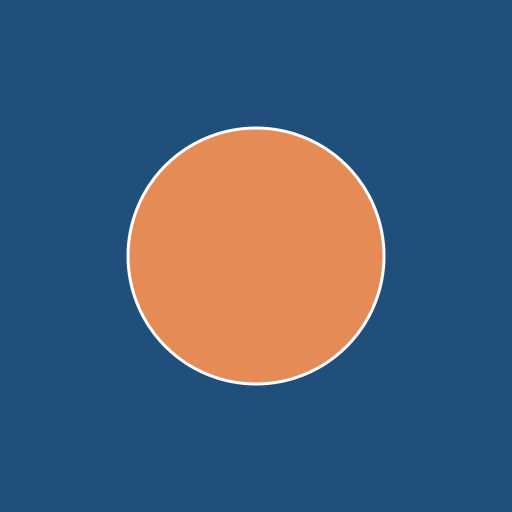
A breathing circle
The smallest figure that exercises the whole path: an implicit curve whose radius follows time, colored on each side of its signed distance. Its second sheet bands both sides by that distance, and not a line of the figure changes.
 002
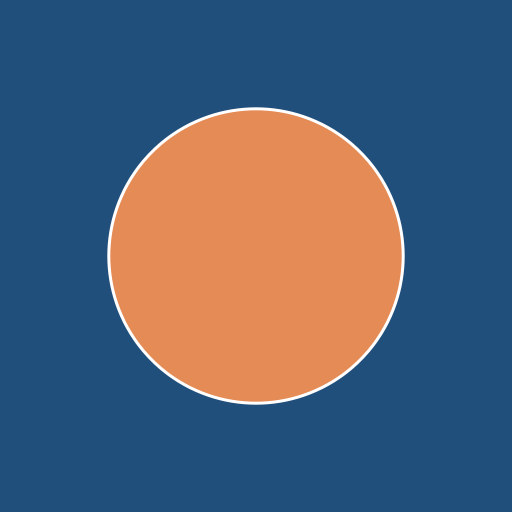
Strokes
Two figures for comparing traced strokes with SVG: a fixed circle filled on both sides, and an open wave whose width is an expression of arc length, which an SVG stroke can’t do.
 003
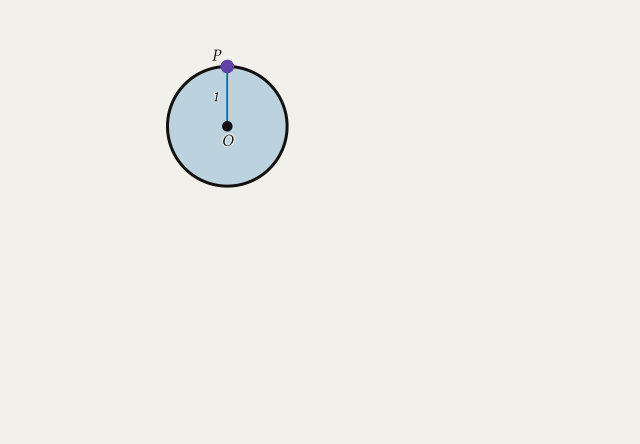
Unwinding a string from a circle
The end of the string traces an involute, and the triangle it makes with the center always has the area of the sector swept so far. The night sheet restyles the same document.
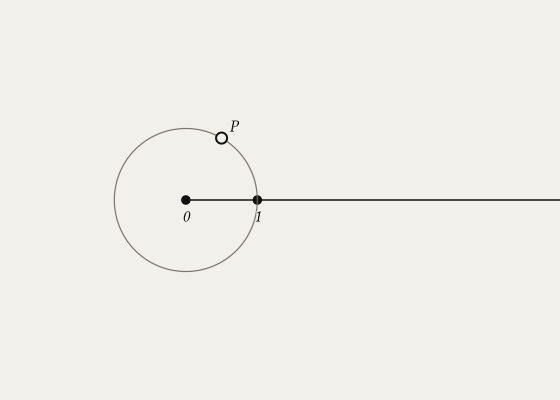 Start with the unit circle and a point P on it, at angle θ.Halfway from 1 to P is B. The circle at 1 through B has radius sin(θ/2): that is k.p = 0: a circle the same size, at P, touches it. Copies keep going around the unit circle, and the ring closes when θ = 360°/q.Its other two neighbors sit on the ray halfway to P, one inside the unit circle and one outside.Mirror them across the real axis: six circles around one, and every circle the same ratio k to its distance from 0.q = 2p: the circle about −½ through cos(θ/2) crosses the unit circle at F. The next neighbors lie in that direction.Two neighbors on that ray, touching the circle at 1 where the ray halfway to F crosses it.And two on the real axis, the direction that is a pure zoom. Each touches its neighbor where that same ray crosses it again.Mirror the pair across the real axis: the q = 2p flower.Every center in both flowers lies on one curve, the level curve of the circle at 1. One way to draw it: the pedal of the circle on the two real-axis centers, seen from 1.Start with the unit circle and a point P on it, at angle θ.Halfway from 1 to P is B. The circle at 1 through B has radius sin(θ/2): that is k.p = 0: a circle the same size, at P, touches it. Copies keep going around the unit circle, and the ring closes when θ = 360°/q.Its other two neighbors sit on the ray halfway to P, one inside the unit circle and one outside.Mirror them across the real axis: six circles around one, and every circle the same ratio k to its distance from 0.q = 2p: the circle about −½ through cos(θ/2) crosses the unit circle at F. The next neighbors lie in that direction.Two neighbors on that ray, touching the circle at 1 where the ray halfway to F crosses it.And two on the real axis, the direction that is a pure zoom. Each touches its neighbor where that same ray crosses it again.Mirror the pair across the real axis: the q = 2p flower.Every center in both flowers lies on one curve, the level curve of the circle at 1. One way to draw it: the pedal of the circle on the two real-axis centers, seen from 1.004
The two boundary flowers, by ruler and compass
The two boundary cases of the Doyle spiral, built step by step around one circle at 1. Step through the beats, or drag P.
 005
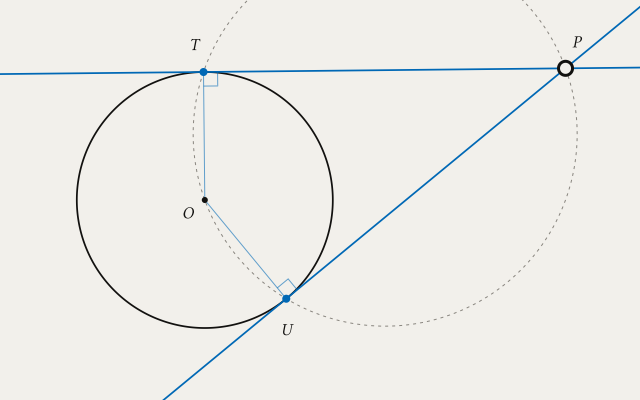
A point and a circle
With P outside the circle, the two tangents from P. With P inside, the chord through P at right angles to OP. Drag P.
 006
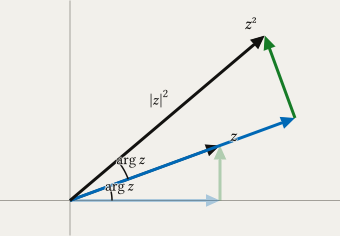
Squaring z = a + bi
F.O.I.L. with arrows: a copy of z scaled by a, another scaled by b and turned by i, and tip to tail they make z², at twice the angle and the length squared.
 007
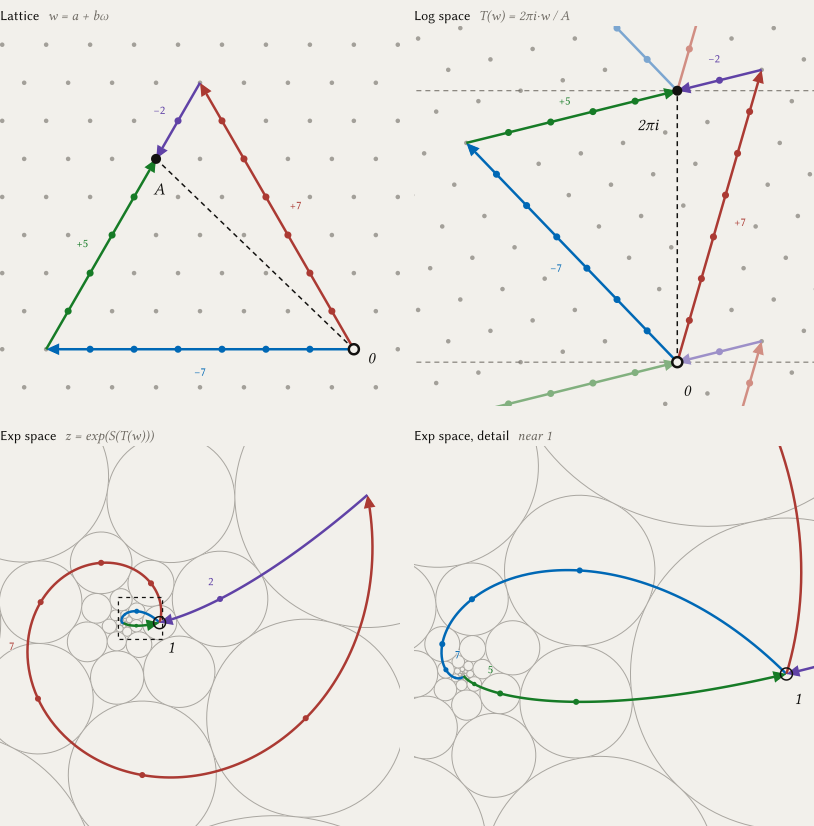
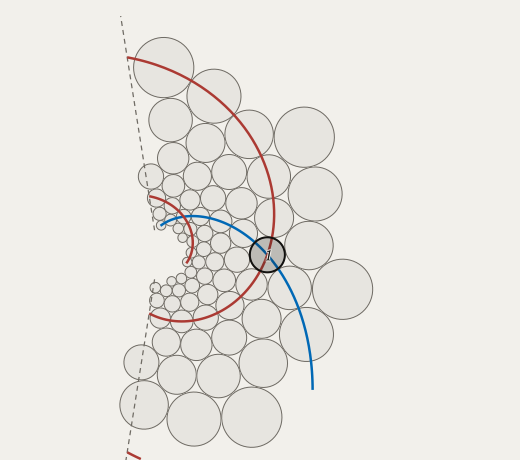
One lattice, through the maps that make a Doyle spiral
Four linked panels of one lattice triangle: the lattice, its image in log space, after exp as a spiral of circles, and a close-up near 1.
lattice.pen · theme.style · plain.style · narrow.style · dark.style
 008
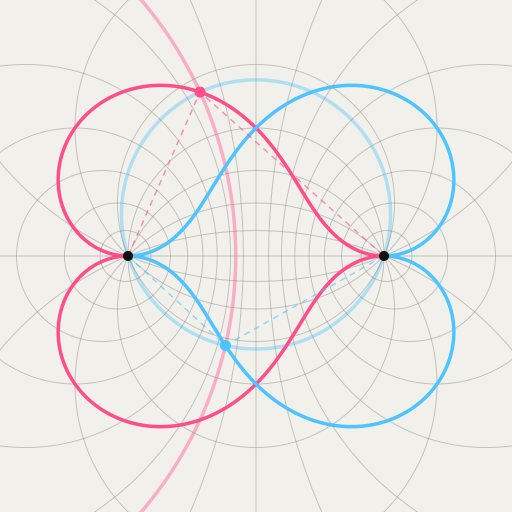
Bipolar hearts
Two hearts in bipolar coordinates around the foci at ±1, over the grid of coordinate circles, with the two circles through a moving point on each. Its second sheet makes every line a light that glows by its distance, and they add where they cross.
hearts.pen · theme.style · plain.style · dark.style · glow.style
 009
The squaring map
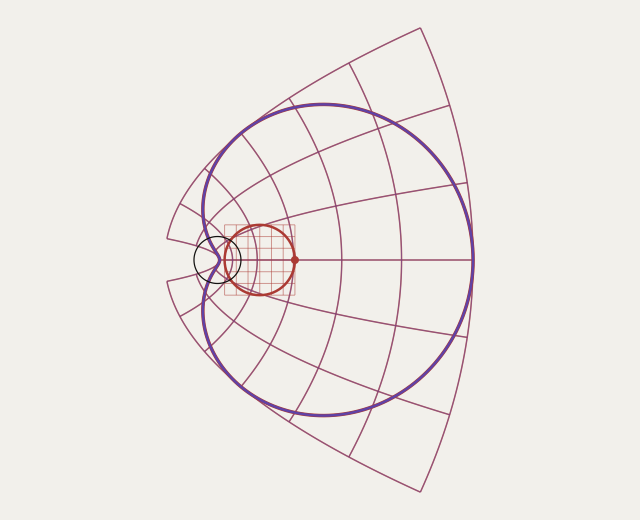
A circle orthogonal to the unit circle, and a grid of lines over the square around it, raised to a power from 1 to 2. The circle becomes a limaçon, and the grid’s lines still cross at right angles, since the map is conformal.
 010
Coxeter’s loxodromic sequence, through a Möbius map
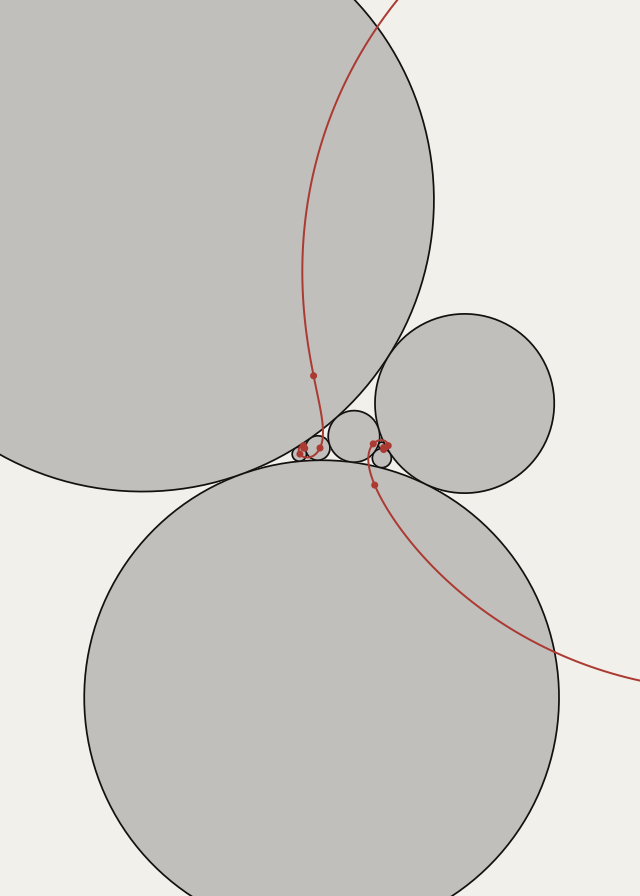
Circles at the powers of w, each touching its neighbors, and their image under a Möbius map, where they still touch. When the pole lands on a circle, that circle is a line for a moment.
 011
A circumcircle, straightening into a line
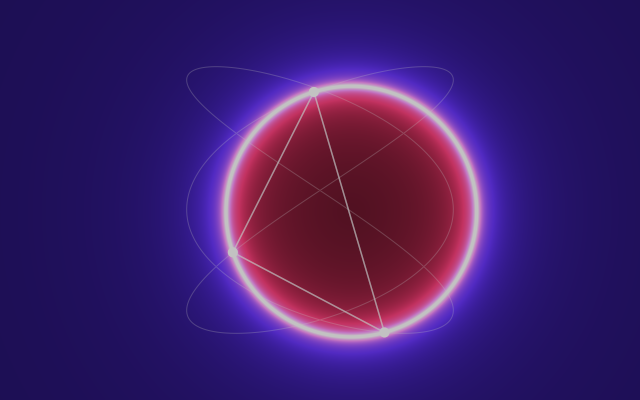
Warm is its negative side. When the three corners line up, the triangle turns over: the circle straightens into a line and comes back the other way round, and that side doesn’t change.
 012
A limaçon, from both sides of its circles
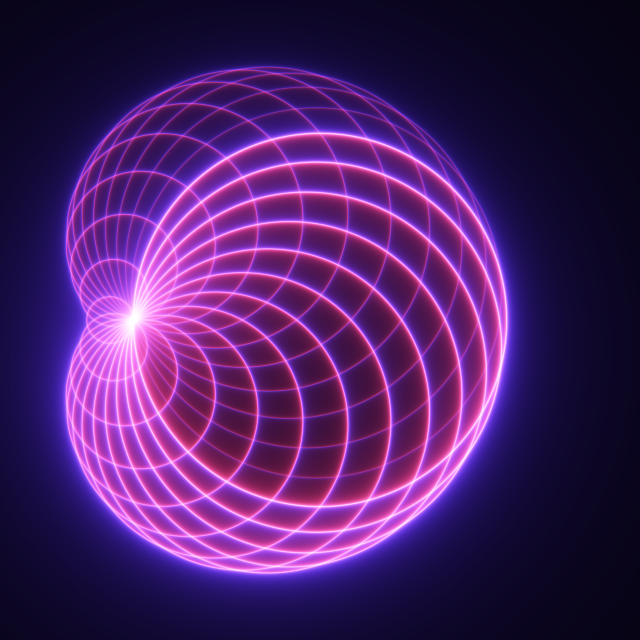
Every circle passes through one point, with its center on a circle, and each is warm inside and cool outside. They add up, and tanh keeps them in range.
 013
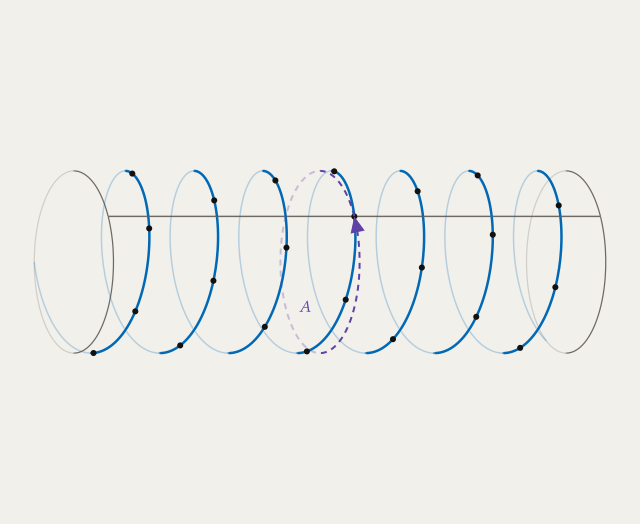
Rolling the strip into a tube
The one-turn strip of the grid, with rows colored by arm, rolling up into a tube. Each row runs off the top and comes back in at the bottom as the next row of its arm, so an arm is one line wound around. Its points are in space, and the sheet fades the far side from
self.z.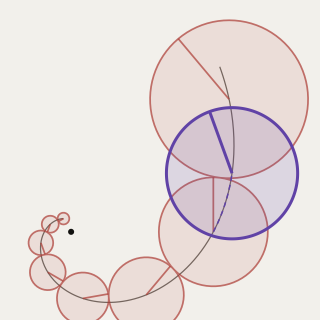 014
A circle of the spiral, scaled and turned
Multiplying by z grows a circle of a log spiral by |z| and turns it by arg z about the center, which lands it on the next circle. A copy of circle 0 is multiplied by zˢ as s runs from 0 to 1, and each circle’s tick shows the turn.
 015
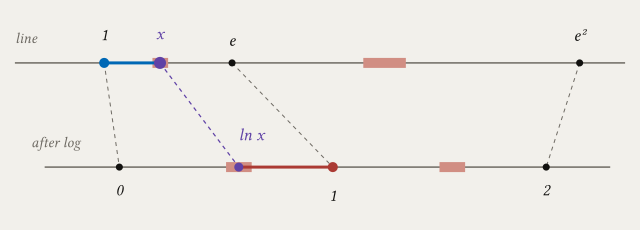
Nearest isn’t nearest after log
Dots at 1, e and e² on the line are evenly spaced after log, at 0, 1 and 2. Each line marks the dot nearest x by its own distance, and they disagree between e^(n+½) and (eⁿ + eⁿ⁺¹)/2, which is shaded on both. Drag x.
 016
Unwrapping the spiral
One slider from the flat strip to the Doyle spiral, through fₜ(u) = (e^(tu) − 1)/t + 1, which keeps 1 fixed. The strip holds one circle of each period, chosen by a whole-number range; the copies a turn above and below fade as it wraps, and the rows along 1 and ω curl into arms.
 017
Coloring the spiral by arm
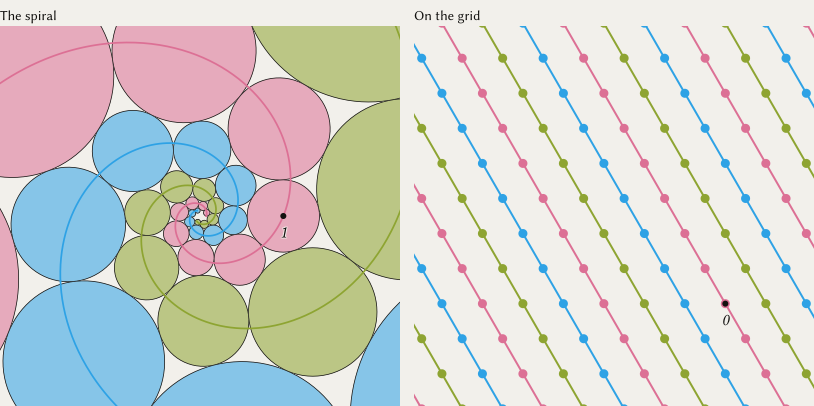
Each circle is colored by which row of the grid it’s on, along ω, 1 or 1 + ω, wrapped around by the number of arms, which is how many rows the period crosses. Each arm’s exact curve runs through its circles, and on the grid each arm is a straight row. Where the rows run along the period they close into rings. The second look adds the period A, which crosses one row of each arm.
arm-colors.pen · theme.style · plain.style · narrow.style · dark.style · period.style
 018
The camera in log space
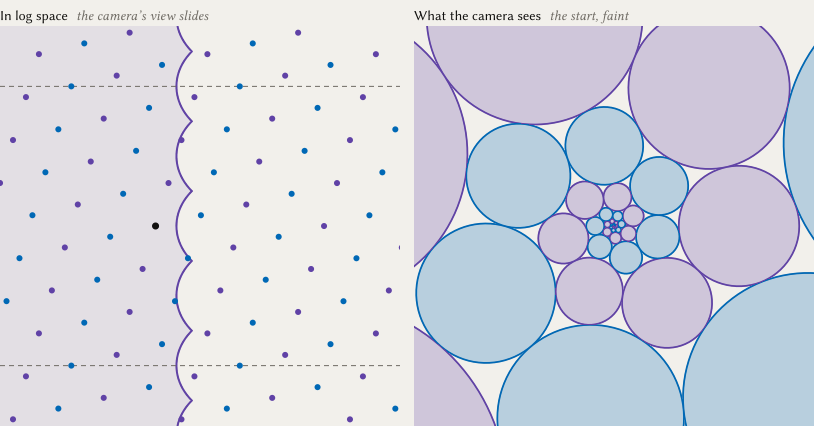
A camera at c sees the spiral times e^(−c), so in log space its square screen is a region with a wavy edge that slides by c. Steps of 1 + ω line the circles up with where they started at every whole step, and the arm colors too after p = 2; a pure zoom as far never lines up.
camera-log.pen · theme.style · plain.style · narrow.style · dark.style
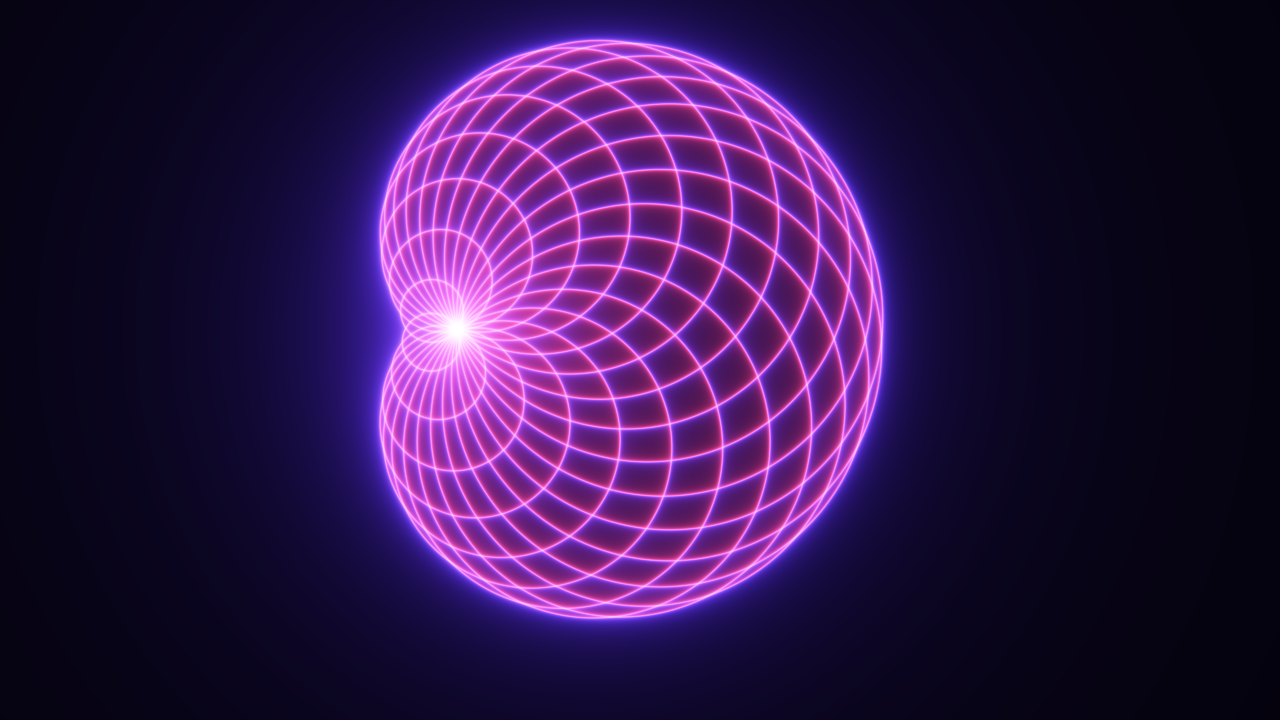 The tangent from 0 touches this circle right above 1.The tangent from 0 touches this circle right above 1.The tangent from 0 touches this circle right above 1.A circle about any point of it, through 1.A circle about any point of it, through 1.A circle about any point of it, through 1.Reflect 1 across the tangent at C.Reflect 1 across the tangent at C.Reflect 1 across the tangent at C.That's where its circle touches the curve.That's where its circle touches the curve.That's where its circle touches the curve.Double the central circle from 1.Double the central circle from 1.The curve is where 1's perpendiculars meet its tangents.The curve is where 1's perpendiculars meet its tangents.The curve is where 1's perpendiculars meet its tangents.Pascal's circle.Seen from 1 its angle is t,and from its center it's 2t.Go sinh 2s farther, both ways.Go sinh 2s farther, both ways.Go sinh 2s farther, both ways.Go sinh 2s farther, both ways.Or add the arms the other way around.The hub, the slow arm, the fast arm.The hub, the slow arm, the fast arm.The hub, the slow arm, the fast arm.That's squaring.u turns at t, and u² at 2t.The tangent from 0 touches this circle right above 1.The tangent from 0 touches this circle right above 1.The tangent from 0 touches this circle right above 1.A circle about any point of it, through 1.A circle about any point of it, through 1.A circle about any point of it, through 1.Reflect 1 across the tangent at C.Reflect 1 across the tangent at C.Reflect 1 across the tangent at C.That's where its circle touches the curve.That's where its circle touches the curve.That's where its circle touches the curve.Double the central circle from 1.Double the central circle from 1.The curve is where 1's perpendiculars meet its tangents.The curve is where 1's perpendiculars meet its tangents.The curve is where 1's perpendiculars meet its tangents.Pascal's circle.Seen from 1 its angle is t,and from its center it's 2t.Go sinh 2s farther, both ways.Go sinh 2s farther, both ways.Go sinh 2s farther, both ways.Go sinh 2s farther, both ways.Or add the arms the other way around.The hub, the slow arm, the fast arm.The hub, the slow arm, the fast arm.The hub, the slow arm, the fast arm.That's squaring.u turns at t, and u² at 2t.Lab
Explainer: the limaçon from its central circle
The first explainer, a draft: beats with captions that build the limaçon from one circle. It’s split into a file for each part of its story, which the element fetches as its
uselines ask.limacon.pen · theme.style · dark.style · limacon.style · caption.style


